
Description
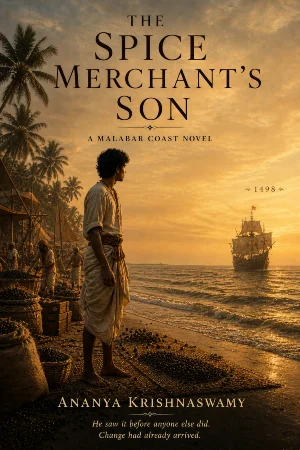
The arrival of Vasco da Gama on the Malabar Coast in 1498 is one of those historical moments that gets taught as an origin story — the beginning of the spice trade, the opening of sea routes, the start of European expansion into Asia. Ananya Krishnaswamy’s debut novel has no interest in that version of events.
Her Calicut is a working port city with a fully functioning economy, a cosmopolitan merchant class, and centuries of established trade with Arab, Chinese, and East African traders before any European ship appears on the horizon. The arrival of the Portuguese is not a discovery. It’s an intrusion into something that was already there.
The Spice Merchant’s Son follows Madhavan, eighteen years old, apprenticed to his father’s pepper trading business, who becomes an interpreter for the Zamorin’s court during the tense negotiations with da Gama’s crew. He speaks Arabic and some Portuguese picked up from traders. He is useful to everyone and trusted by no one.
Krishnaswamy researched this novel for four years and it shows — but not in the way that historical fiction usually shows its research, as a kind of weight. The detail here is sensory. The smell of pepper drying on mats, the specific protocols of a merchant meeting, the layout of a Nair household, the food. Especially the food.
A remarkable debut. The ending is not hopeful but it is honest, which in this context is the same thing.




Reviews
There are no reviews yet.