
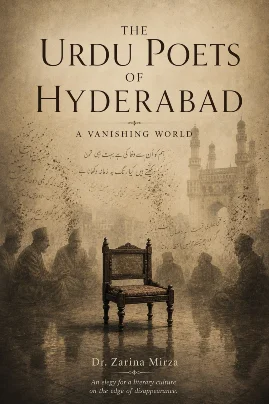
Description
The Nizam’s Hyderabad had a literary culture that operated in a different register from the better-documented Urdu traditions of Lucknow and Delhi. It was older in some ways — Deccani Urdu predates the classical period of north Indian Urdu by at least two centuries — and stranger, shaped by the Deccan’s particular mixture of Persian, Telugu, Kannada, and Marathi influences.
Dr. Zarina Mirza has spent thirty years documenting what remains of that world. The Urdu Poets of Hyderabad is the result — part literary history, part oral archive, part elegy. She has interviewed the last poets who attended the great mushaieras of the 1960s and 70s, the students of poets who are now dead, the families who still have manuscripts in languages nobody in the household can read.
The book’s central argument is that the merger of Hyderabad into India in 1948, followed by the violence of the police action, and then the linguistic reorganisation of states in 1956, broke the cultural continuity that had sustained Hyderabadi Urdu for three centuries. Not destroyed it — broke it. The tradition continued, but in a different register, more self-conscious, more aware of its own precariousness.
The translations of Deccani Urdu poetry are Mirza’s own, and they are worth the book alone. She is a poet herself and the English versions carry something of the originals without pretending to be equivalent. Her footnotes on the specific resonances that get lost in translation are models of scholarly honesty.
This is the kind of cultural documentation that becomes irreplaceable within a generation. An essential book.
Reviews
There are no reviews yet.