



book meeting rooms and venues online
Nobody picks the venue. That’s the part everyone gets wrong. You start a book club, agonise over the first title, draft the invite three times and then default to whoever’s flat is free or the café round the corner because it’s central. The where is an afterthought. Six weeks in, attendance is down to four and you’re blaming the book.
It usually wasn’t the book.
Why a Noisy Café Quietly Kills the Discussion
A discussion needs a room that lets people disagree. That sounds abstract until you’ve watched it fail. Picture the club that meets in a busy café — good coffee, queue out the door. Twelve people came the first night.
The trouble is acoustic before it’s anything else. You can’t argue across a table when you’re half-shouting over an espresso machine and the group at the next table is clearly listening. So people stop arguing. They nod. They say the book was “interesting.” The quiet ones never get a word in, because getting a word in means raising your voice and raising your voice in a café feels like a performance. Within a month the only people left are the three who’d have come anywhere. The club is really just a coffee.
What Changes the Moment You Close a Door
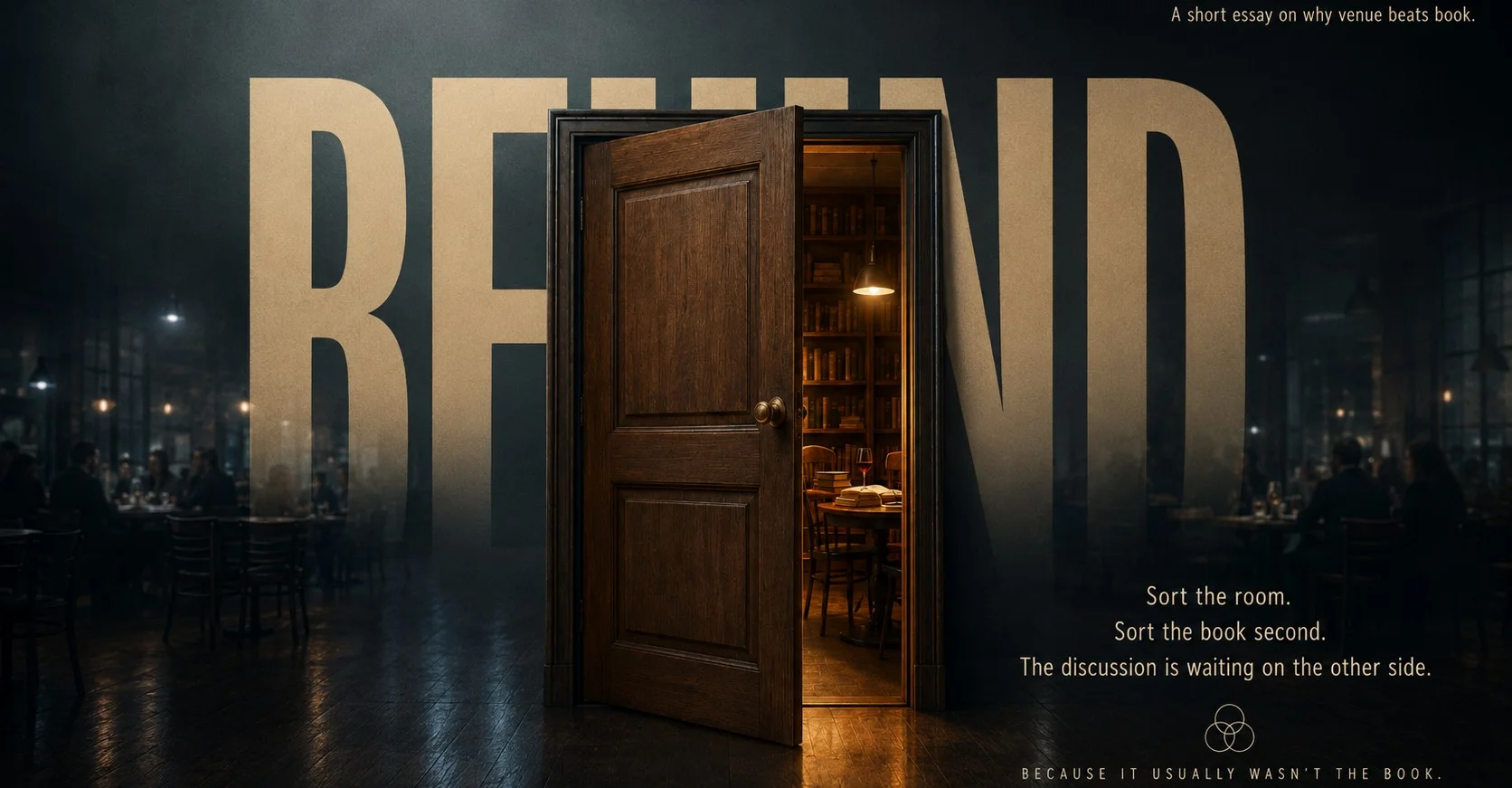
Move the same people into a back room with a door that closes and watch what happens. Someone says they hated the ending — actually hated it, not “found it challenging” and because there’s no audience, no machine, no queue, the disagreement gets to breathe. Someone else pushes back. Suddenly it’s a real conversation, the kind people clear their evening for. The book didn’t change. The acoustics did.
Here’s the mechanism most people miss: a book discussion is a low-status activity in public space. In a café or bar you’re a slightly odd group hogging a table and underspending and everyone nearby can hear your half-formed opinion. That self-consciousness flattens the talk. Behind a closed door — a library meeting room, a bookshop’s event space, a community-centre side room — the social cost of saying something unfinished drops to almost nothing. People take risks with their thinking.
This matters more for some books than others. Take a novel like Anindita Ghose’s The Illuminated — a story about a mother and daughter set against a country growing more intent on telling women who to be. That’s not a book you discuss with a verdict and a star rating. It’s one where someone in the room will disagree with how Tara is drawn or read Shashi’s grief in a way you hadn’t and the conversation only goes anywhere if people feel safe enough to say the uncomfortable thing. A room that flattens disagreement flattens exactly that book.
The Small Venue Choices That Decide the Night
A few things worth knowing, the kind nobody tells you until you’ve made the mistakes:
- A round table or loose circle beats a long rectangle. On a long table the two ends form their own conversations and the middle referees. A circle has no head — exactly what you want.
- Eight to ten is the ceiling for one conversation. Past that it fractures into side-chats no matter how good the room. A bigger club doesn’t need a bigger space; it needs to split into two rooms and rejoin at the end.
- Booked beats borrowed. A space someone reserved, even a free library room, carries a weight of intention a mate’s living room doesn’t. People show up differently to a thing that was arranged.
Why “Booked” Beats “Borrowed” Every Time
That last point is the quiet one. There’s a reason “we’ll just meet at mine” clubs tend to fizzle while clubs that book a regular room tend to last. The borrowed space is always provisional — easy to cancel, easy to skip. A reserved room on a recurring slot becomes a commitment with a shape. It’s on the calendar. It’s a place. A club that has a place is a club still running this time next year.
Sort the Room Before You Sort the Book
So before you fret over the next title, sort the room. Find one with a door. The discussion you want — the one where people actually say what they think — is waiting on the other side of it. At DesiTales2 that’s the kind of reading life we’re interested in: books worth arguing over and the conditions that let the argument happen.

info@desitales-2.com
I'm a writer and journalist based in Mumbai. Before fiction, I spent years in magazines — features director at Vogue India, then editor of Mint Lounge — writing on art, books and culture. My debut novel, The Illuminated (HarperCollins India; Head of Zeus internationally), came out in 2021, a story about a mother and daughter finding themselves in a country increasingly intent on telling women who to be. I've since edited The Only City, an anthology of stories about Bombay. Right now I'm collaborating with DesiTales2 on a new project rooted in the books and culture writing I care most about — cultural storytelling that doesn't flatten where it comes from.
Leave a Reply