
Description
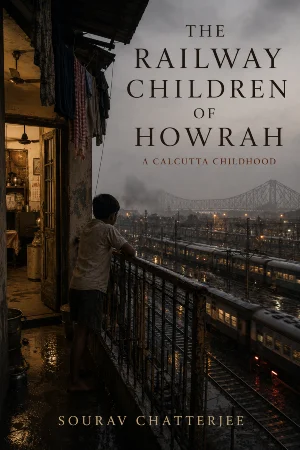
Debashish Ghosh’s childhood home in Howrah was in a building whose back wall touched the railway yard. He could feel the Rajdhani Express leaving at 4:55 PM from his bedroom. This is not a metaphor in his memoir. It is a literal physical fact that shaped everything — sleep schedules, conversation rhythms, the particular way his family timed their meals around departures.
The Railway Children of Howrah covers the years 1979 to 1992, which is to say the heart of the Left Front period in West Bengal, when Kolkata was simultaneously the most politically conscious city in India and the one most visibly falling apart. Ghosh writes about this with the specificity of someone who lived it — the bandhs that meant no school, the neighbourhood party office where his father played cards with the local councillor every evening, the specific way that ideology and daily life were woven together in a working-class Bengali household.
The Howrah Bridge is the book’s constant presence — Ghosh walked across it thousands of times and he writes about it not as a landmark but as a daily fact, the way you write about a piece of furniture in a house you grew up in. The chapter about crossing it during the 1984 riots is the book’s most harrowing, written in a flat tone that makes it more rather than less disturbing.
The food sections have already been excerpted and shared widely — Ghosh writes about his mother’s cooking with the precision of someone who learned to cook by watching and then spent decades trying to reproduce what he tasted in childhood. The recipe for her mustard hilsa, reconstructed from memory over five attempts, is included as an appendix.
Funny and sad and specific in the way that the best memoirs are specific — so detailed about one place and time that it somehow becomes universal.

Reviews
There are no reviews yet.